
Searching for "companies that sponsor visas in Ireland" is a natural first step for many non-EU professionals. But the search results often give you a list of big brand names — Google, Meta, Stripe — without explaining whether those companies are actually hiring in your field, or what "sponsorship" even means in the Irish system.
This article explains how to use publicly available employment-permit data as a research tool, not a shortcut. You will learn what DETE permit figures actually show, how to distinguish visible permit activity from a sponsorship guarantee, and how to build a focused employer target list that matches your role, sector, and permit route.
What DETE employment-permit data actually shows
The Department of Enterprise, Tourism and Employment (DETE) publishes data on issued employment permits [1]. This data shows which companies have previously obtained permits for specific roles, in specific years. It tells you that an employer has engaged with the Irish employment-permit system — not that they are currently hiring for your role.
Key points to understand:
- Permit data is historical. A company that issued 50 permits in 2024 may have different hiring needs in 2026. Economic conditions, headcount freezes, restructuring, and sector changes all affect current demand.
- Permit data does not show current vacancies. DETE numbers are issued permits, not open job ads. An employer with strong permit history may have zero openings in your field right now.
- Permit data does not show application outcomes. The numbers tell you permits were issued, not how many applications were submitted, rejected, or withdrawn.
- Industry, city, and role variation matters. An employer with high permit numbers in software engineering may have minimal activity in other fields. Filtering by sector and role is essential.
"Employment-permit activity" vs "sponsorship guarantee"
One of the most common mistakes candidates make is treating permit history as a guarantee of future sponsorship. Here is a safer way to think about it:
| What permit activity tells you | What it does NOT tell you |
|---|---|
| This employer has navigated the DETE permit process before | This employer will sponsor your specific role |
| This employer has experience with permit timelines and requirements | This employer is currently hiring in your field |
| This employer is visible in the Irish employment-permit system | Your application will result in a permit |
| This sector shows demand for international talent | Your salary will meet current DETE thresholds |
Employers with visible employment-permit history may be more useful research targets than employers with no visible signal, but past activity is not proof of current hiring or future sponsorship [1][3].
How to use the IrishTalents company directory as a research tool
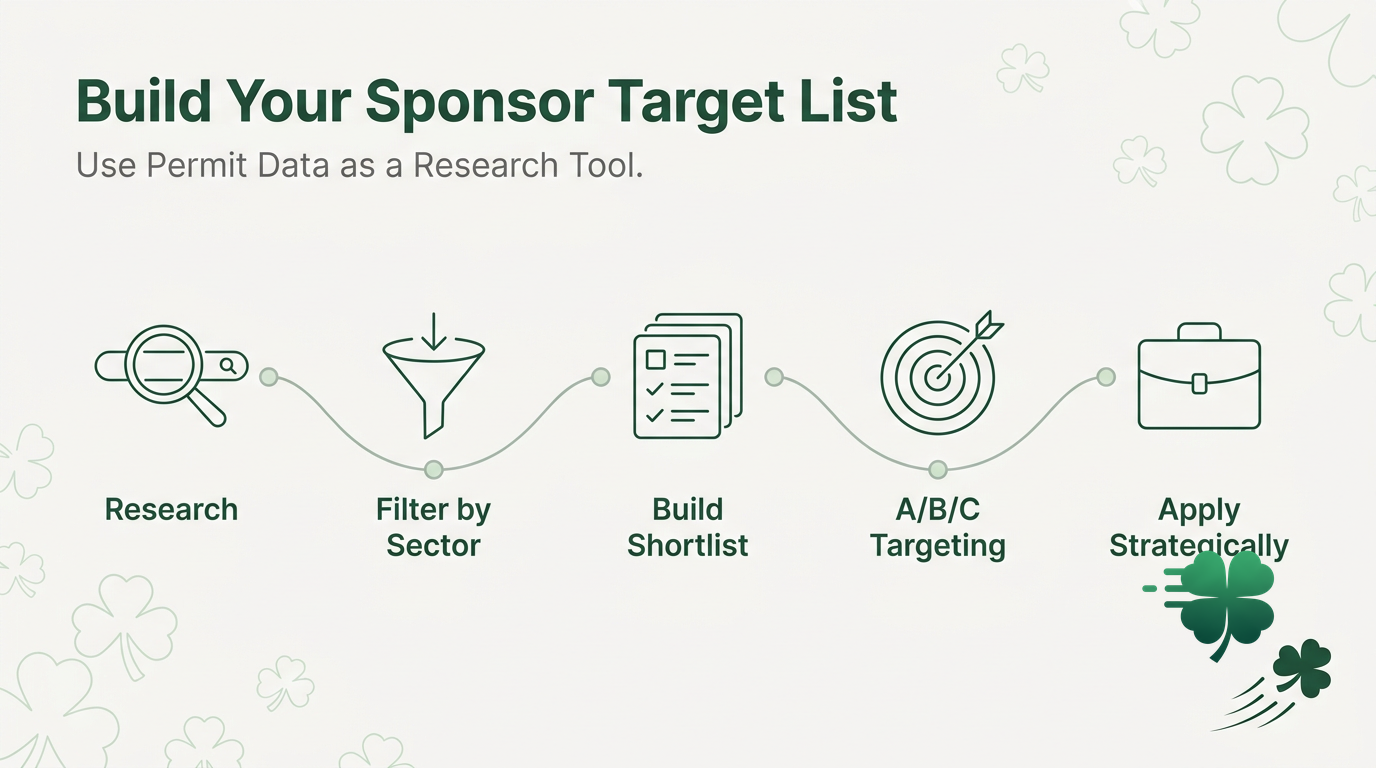
The IrishTalents company directory surfaces DETE employment-permit data in a searchable, filterable format. Here is a practical workflow for using it to build your target list:
Step 1: Filter by sector and city
Start broad, then narrow. If you are a mechanical engineer, filter by the Construction & Engineering sector first. If you are a nurse, filter by Healthcare & Social Care. Add a city filter — Dublin, Cork, Galway — only after you have confirmed that relevant employers exist in your sector nationally. Some of the strongest demand is outside Dublin [1].
Step 2: Look at the permit numbers, not just the company name
A company with 5 permits over 3 years in your sector is a very different research target from a company with 50 permits in the most recent year. Neither is a guarantee, but the signal strength is different. Use the permit count as a filter, not a score.
Step 3: Check the company profile for enrichment data
Each IrishTalents company profile includes enrichment data where available: industry classification, city, website, LinkedIn presence, and canonical URL. A company with a complete profile — website, industry, location — is easier to research than a bare entry with only a name.
Step 4: Cross-reference with current job ads
Once you have a shortlist of employers with permit history, check their careers pages and current job listings. An employer with 20 permits in 2025 AND open roles matching your profile is a stronger target than an employer with permit history but no visible openings.
Step 5: Separate A/B/C targets
Not all employers on your list deserve equal attention:
- A targets: Employers with recent, high-volume permit activity in your sector AND current openings matching your role. These are your top priority.
- B targets: Employers with moderate permit activity in your sector or adjacent sectors. Worth researching and applying if roles appear.
- C targets: Employers with minimal or very old permit activity. Keep on your radar but do not spend most of your time here.
What to do after you find a company with permit history
Finding an employer with permit history is step one. What you do next determines whether the data helps you or leads you in circles.
Research before you apply
Before sending a CV, check:
- Does the employer have current job ads matching your role and experience level?
- Does the role description and salary range look compatible with the relevant employment-permit route? See our guide on what a SOC code means for Irish employment permits.
- Has the employer sponsored permits in your specific field recently, or only in unrelated roles?
- Is the employer listed with a complete Irish entity, or is the entry ambiguous?
Prepare for employer conversations
When you reach out to an employer with permit history, do not lead with "will you sponsor me?" Instead, show that you understand the process:
- Reference the fact that the employer has experience with the Irish employment-permit system.
- Explain how your role and duties align with a likely employment-permit route.
- Be ready to discuss timelines, salary expectations, and processing steps.
Employers who have navigated the DETE process before are generally more familiar with the requirements. But familiarity is not commitment. Your job is to make the case that hiring you is worth the process.
Use permit data as one signal among many
Permit history is useful, but it is not the only factor that matters. Combine it with:
- Your employment permit fit — use the Irish employment permit fit check.
- Current job market signals in your sector.
- Employer size, stability, and reputation.
- Your personal timeline, especially if you are on Stamp 1G with limited time remaining.
Common mistakes when using permit data
Mistake 1: Treating the largest permit numbers as the best targets. A multinational with 500 permits may have 500 applicants per role. A mid-size company with 10 permits in your specific field may be a more realistic target.
Mistake 2: Ignoring employers with lower but consistent permit activity. An employer with 3-5 permits per year for several years shows sustained engagement with the system, not a one-off hiring spike.
Mistake 3: Applying to every company on the list without checking current openings. Spray-and-pray wastes your time and the employer's. Filter by sector, role fit, and current demand before applying.
Mistake 4: Assuming permit data guarantees a smooth process. An employer with 100 permits still needs to meet DETE requirements for each new application. Labour Market Needs Tests, salary thresholds, and permit processing times still apply [3].
Mistake 5: Focusing only on famous brand names. Google, Meta, and Stripe have permit history, but so do hundreds of other employers in healthcare, construction, finance, pharma, and professional services. The directory includes employers you may not have considered.
Key takeaways
- DETE employment-permit data shows historical permit activity — not current vacancies, hiring intentions, or sponsorship guarantees.
- Employers with visible permit activity are useful research targets, but past activity is not proof of future hiring.
- Building a focused A/B/C target list — filtered by sector, role, and current openings — is more effective than applying broadly.
- Cross-reference permit data with current job ads, employer research, and your own permit fit before investing time in applications.
- The IrishTalents company directory is a research tool to help you build a smarter target list, not a list of guaranteed sponsors.
Next step
Start building your target list. Explore the IrishTalents company directory with sector and city filters, then cross-reference employers with your employment permit fit using the Irish employment permit fit check.
For a deeper guide on researching individual companies, see how to research a company's visa sponsorship history before applying.
Sources
[1] Department of Enterprise, Tourism and Employment — Employment Permits: https://enterprise.gov.ie/en/what-we-do/workplace-and-skills/employment-permits/
[2] Irish Immigration Service — Coming to work in Ireland: https://www.irishimmigration.ie/coming-to-work-in-ireland/
[3] DETE — Critical Skills Employment Permit: https://enterprise.gov.ie/en/what-we-do/workplace-and-skills/employment-permits/employment-permit-types/critical-skills-employment-permit/
[4] DETE — General Employment Permit: https://enterprise.gov.ie/en/what-we-do/workplace-and-skills/employment-permits/employment-permit-types/general-employment-permit/
Irish employment permit rules are set by the Department of Enterprise, Tourism and Employment (DETE). This article is a planning framework, not legal or immigration advice. Permit data shows historical activity, not current hiring. Always verify current requirements with official government sources.