
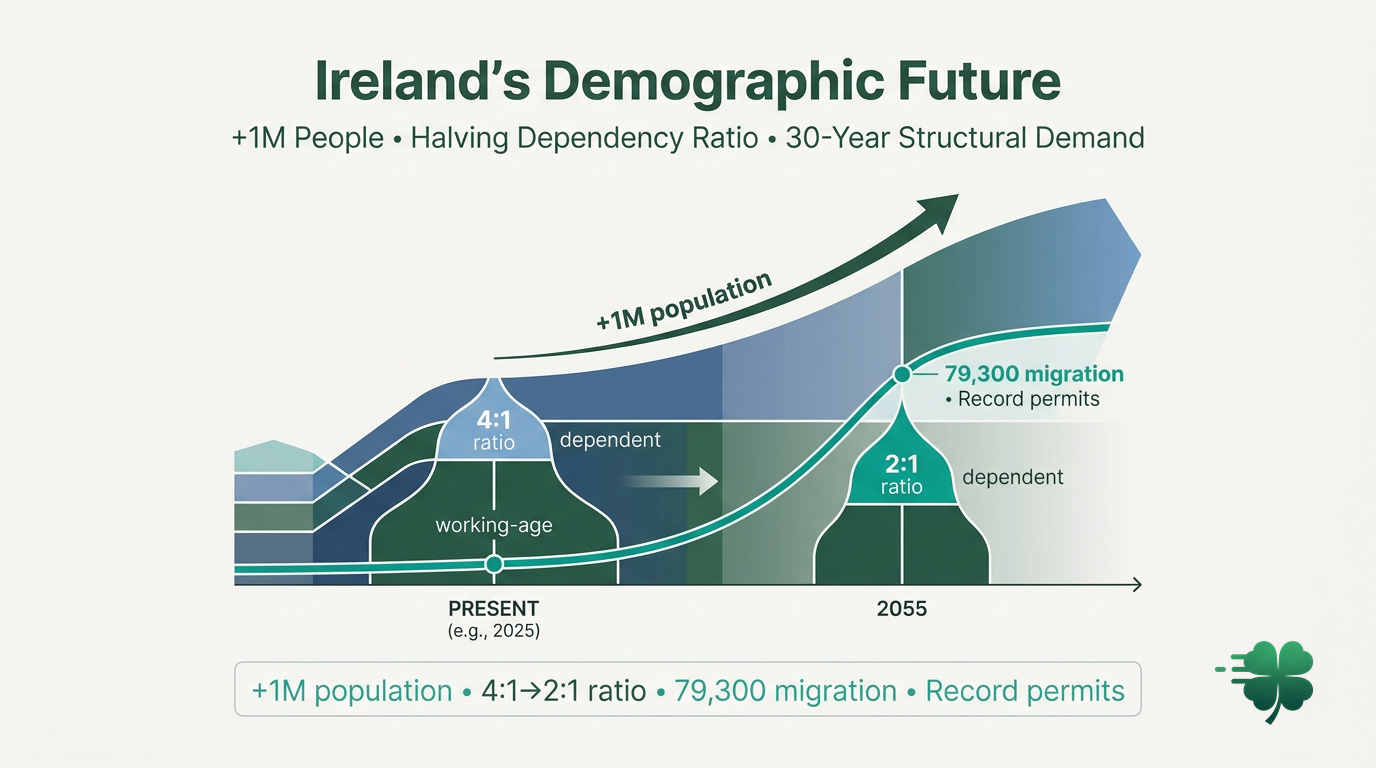
When international candidates ask whether Ireland's sponsorship market is temporary, the short answer is no. But the short answer is not enough. You need the evidence — and the evidence comes from Ireland's own government.
The EGFSN (Expert Group on Future Skills Needs) published a major report in 2026 — "Skills Needs for Ireland in the Long-term" — examining Ireland's workforce trajectory through 2055 [1]. It is not a lobbying document. It is the government's own expert analysis, and it contains four numbers that explain why foreign workers will remain structurally necessary for decades.
This article is the visual companion to our flagship long-term skills needs analysis, which covers what the data means for your sponsorship strategy in detail. Here, we focus on the demographic story itself — the numbers that make everything else predictable.
Data note: EGFSN projections are long-term structural trends, not job vacancies, sponsorship guarantees, or individual immigration outcomes. Employment-permit statistics show permits issued, not current hiring. Use this data as a directional targeting signal, not a promise.
This article is for informational purposes only. Official employment-permit requirements may change, and individual circumstances vary.
The four numbers that explain everything [1]
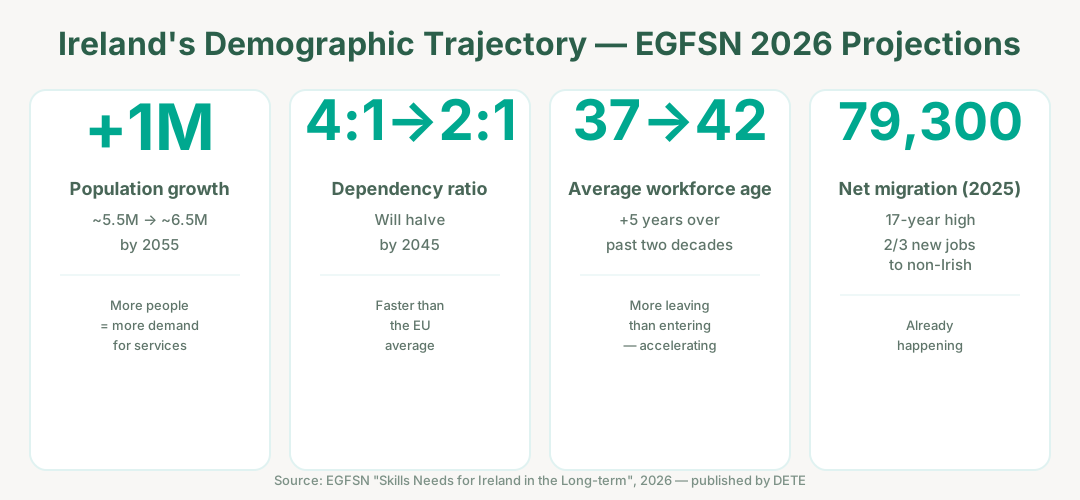
These four numbers are not separate signals. They form a single story: Ireland's domestic workforce cannot meet its own demand. The EGFSN is explicit — without migration, labour constraints would be "considerably more binding" [1].
Where the numbers meet today's permit data
The demographic projections are not abstract. They already overlap with current employment-permit activity.
In 2024, Ireland issued 39,390 employment permits, the second-highest annual total on record, just below the 39,955 permits issued in 2022 [2][5]. The total fell to 31,044 in 2025, so the latest complete year does not support describing the trend as a straight-line record every year [3]. The current 2026 official files record 19,044 permits through June, a partial-year signal that should be read separately from the completed annual totals [4].
The sectors driving this demand are precisely the ones the EGFSN identifies as structurally constrained:
- Healthcare and Social Care: 12,501 permits in 2024 and 7,948 in 2025 [2][3]. The EGFSN explicitly calls for "more resources in the broad health care sector" [1].
- Agriculture and food manufacturing: DETE reports these separately. Agriculture, Forestry & Fishing accounted for 3,625 permits in 2024 and 1,915 in 2025; Manufacture of Food, Drink & Tobacco accounted for 353 and 496 respectively [2][3]. The agriculture signal also sits alongside an ageing workforce where close to 9 in every 10 workers are aged 50 or above — roughly three times the economy average [1].
- Information and Communication: 6,788 permits in 2024 and 3,630 in 2025 [2][3], showing material activity but not a guarantee of current vacancies or future sponsorship.
The EGFSN does not say "hire more foreign workers." It says Ireland's own workforce trajectory creates structural demand that cannot be met domestically. The DETE permit data shows that demand is already materialising.
What this means for your sponsorship strategy
The demographic direction is clear: Ireland will need foreign workers across multiple sectors through at least 2055. This does not guarantee that any individual candidate will secure sponsorship. It means that the forces driving sponsorship demand are structural, not cyclical.
For a deeper analysis of how to use this data in your job search — including sector-by-sector breakdowns, professional registration requirements, and a practical framework for prioritising your target employers — read our flagship long-term skills needs post.
If you are ready to research which employers have the strongest sponsorship track record in your sector, start with IrishTalents sponsor companies.
Sources
[1] EGFSN, "Skills Needs for Ireland in the Long-term", 2026 — published by the Department of Enterprise, Tourism and Employment (DETE). Available at: https://enterprise.gov.ie/en/publications/skills-needs-for-ireland-in-the-long-term.html
[2] DETE, Permits by sector 2024 (official XLSX). Available at: https://enterprise.gov.ie/en/publications/publication-files/permits-by-sector-2024.xlsx
[3] DETE, Permits by sector 2025 (official XLSX). Available at: https://enterprise.gov.ie/en/publications/publication-files/permits-by-sector-2025.xlsx
[4] DETE, Employment permits by sector 2026 (official XLSX; current file through June 2026). Available at: https://enterprise.gov.ie/en/publications/publication-files/employment-permits-by-sector-2026.xlsx
[5] DETE, Permits by sector 2022 (official XLSX). Available at: https://enterprise.gov.ie/en/publications/publication-files/permits-by-sector-2022.xlsx