
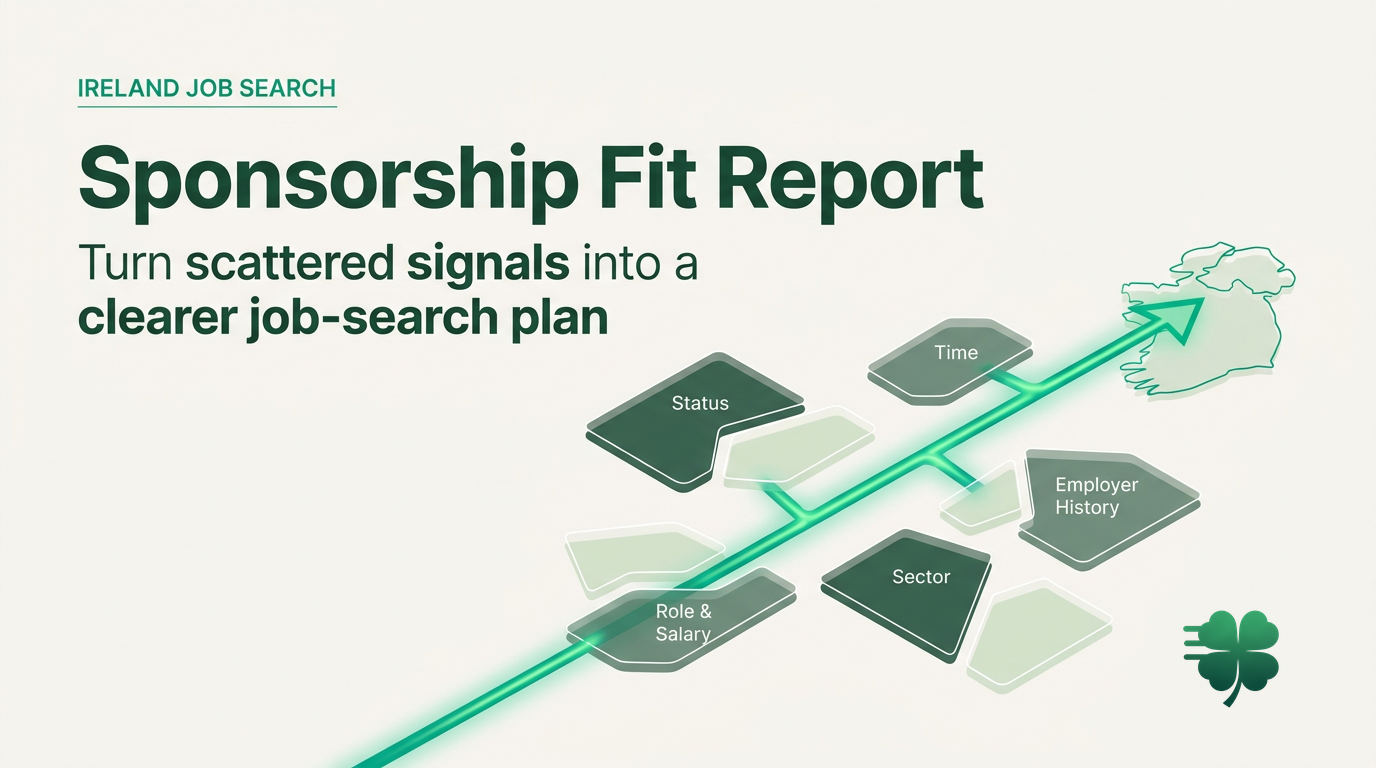
You can have a strong CV, a relevant degree, and years of experience — and still spend weeks applying to employers who were never a sensible target for your sponsorship search. The problem is often not effort. It is that the important signals are scattered across your status, role, timing, salary expectations, sector, and employer research.
The Sponsorship Fit Report is designed to bring those signals into one planning view. It helps you understand where your search looks coherent, where it needs verification, and which decisions deserve attention before you send another batch of applications.
It is a research and planning tool, not a job offer, a permit application, or a legal opinion. It does not guarantee employment, sponsorship, or permit approval. Official requirements can change, and your individual circumstances matter.
What the report is trying to answer
A sponsor list answers a narrow question: which employers have appeared in employment-permit data? That is useful, but it is not enough to decide where you should focus.
The report is meant to help you ask a more practical set of questions:
- Does my current status create a time-sensitive decision?
- Does my role need a closer look at duties and occupation classification?
- Is my salary expectation compatible with the route I need to verify?
- Which sectors and employer patterns deserve research first?
- What is clear enough to act on, and what still needs official confirmation?
That distinction matters. A company with historical permit activity may still have no suitable vacancy today. A company without visible history may still be able to support a permit application in the right circumstances. The report helps organise the research; it does not turn historical signals into predictions.
The six signals the report brings together
1. Status and time
Your starting point changes the order of decisions. Someone already in Ireland on Stamp 1G may be working against a different clock from someone applying from abroad. A student, graduate, or professional with existing permission may also need to clarify what work is permitted now and what would need to change later.
The report treats status and time as context for planning. It does not decide which immigration route applies to you. For current rules, consult the Department of Enterprise, Tourism and Employment (DETE) and, where appropriate, a qualified immigration adviser.
2. Role and duties
Job titles can hide important differences. Two people called “analyst” may have very different duties, qualifications, and occupation classifications. The useful question is not only what your title says, but what you actually do and how that work maps to the relevant Irish employment-permit framework.
Use this signal to identify questions for further research: which duties define your role, which qualifications support them, and whether the current official occupation lists need to be checked. The report can help you spot the issue; it does not provide an official SOC classification or eligibility decision.
3. Salary expectations
Salary is another input that needs context. Current remuneration requirements vary by permit route and may change, so a report result should never replace checking the latest official DETE guidance.
A high salary does not solve every other gap. Role classification, employer support, qualifications, and the details of the proposed job still matter. Treat the salary signal as a prompt to verify your target roles and expectations, not as a guarantee that an application will qualify.
4. Sector
Sector context helps you decide where to spend research time. Some candidates search only by job title and miss employers in adjacent industries where their experience could be relevant. Others treat a high-profile sector as automatically suitable without checking the actual duties and employer pattern.
A good result should lead to a shortlist, not a conclusion. Compare the sector signal with current vacancies, role requirements, employer information, and your own evidence. The IrishTalents company directory is a useful place to continue that employer-research step.
5. Employer permit history
Historical permit activity can be a valuable targeting signal. It can help you identify employers worth investigating instead of treating every company as equally likely to understand or support international hiring.
But history has limits. It does not prove that an employer is hiring now, that it supports your specific occupation, or that it will sponsor your application. Read it alongside the vacancy, the employer's current careers information, and the relevant official guidance. The company sponsorship-history guide explains how to do that without over-reading the data.
6. Readiness gaps
The most useful part of a report may be the gap it exposes. You might need clearer role evidence, a more targeted CV, better employer research, professional registration, or a plan for what to verify next.
This is where a result becomes actionable. Instead of trying to improve everything at once, choose the gap most likely to change your next decision. A candidate with a clear role but a weak target list needs a different next step from a candidate with strong employer research but unresolved documentation questions.
How to read your result
Read the report as a set of signals with different levels of certainty:
- Start with the strongest signal. What is already clear from your profile and research?
- Find the blocking uncertainty. Which unanswered question could make your shortlist unusable?
- Separate research from confirmation. A historical employer signal is research; current DETE guidance and the actual job details are confirmation steps.
- Choose one next action. Refine the target role, improve your positioning, verify a route, or build a better employer shortlist.
For example, imagine a process engineer who has relevant experience but is applying broadly to unrelated office roles. The report may not “find the right job”. It can, however, make the mismatch visible: the candidate may need to describe their technical duties more precisely and research manufacturing employers before changing their CV again.
Or consider a Stamp 1G graduate with limited time remaining. Their next action may be to narrow the employer list and verify current permit guidance quickly, rather than spending another month making small cosmetic changes to a general CV.
What to do after the report
Use the result to build a short, evidence-based sequence:
- If your employer targeting is unclear: research companies with relevant permit history and current roles in IrishTalents' company directory.
- If your role or route needs verification: use the visa eligibility check as a planning aid, then confirm the current official requirements.
- If your positioning is the weak signal: rewrite your CV and LinkedIn around the duties, outcomes, and keywords that match your target roles.
- If timing is the main concern: prioritise the questions that could change your route or shortlist, and seek qualified advice where your circumstances require it.
The goal is not to produce a flattering score. It is to reduce avoidable uncertainty before you invest more time in applications.
What the report cannot tell you
The Sponsorship Fit Report cannot tell you that you will receive a job, sponsorship, or employment permit. It cannot replace official DETE guidance, an employer's decision, professional registration requirements, or qualified legal and immigration advice.
It also cannot prove that a company is hiring today. Permit history is historical evidence. It should be used to choose better research questions, not to promise an outcome.
For the official starting point, review the Department of Enterprise, Tourism and Employment employment-permit guidance. Requirements may change, and specific circumstances vary.
A more focused next step
If you are unsure whether your current search is pointed at the right employers, start by generating your Sponsorship Fit Report, which is free, and reading the signals it brings together. Then use the result to make one concrete decision: refine your role, verify a permit question, or build a more relevant employer shortlist.
That is the practical value of sponsorship fit. It does not remove uncertainty from an Ireland job search. It helps you spend your next hour investigating the uncertainty most likely to matter.