
The short answer
From the Irish Immigration Service and DETE pages listed under Official baseline below [1][2]:
- How long you have. Stamp 1G under the Third Level Graduate Programme lasts 12 months for a Level 8 award. A Level 9 award or above gets 12 months, renewable for a further 12 months if you show you took steps to find graduate level work. Time on Stamp 2 and Stamp 1G together cannot exceed seven years, or eight if you re-enter the Programme on a higher award.
- What you can do on it. Work full time without an employment permit, with no salary threshold. You cannot be self-employed or run a business.
- What you need after it. An employment permit for a specific job. On the Critical Skills route that means EUR40,904 a year for an occupation on the Critical Skills list, or more than EUR68,911 for one that is not listed. On the General Employment Permit the standard minimum is EUR36,605.
- The deadline inside the deadline. The lower graduate thresholds, EUR36,848 on Critical Skills and EUR34,009 on the General Employment Permit for a relevant Irish degree, apply only when the qualification was received in the 12 months before the permit application. On a 24-month Stamp 1G, that cheaper threshold runs out halfway through.
None of this decides an application. Immigration permission and permits are decided case by case by the Irish Immigration Service and DETE, so confirm your own dates with them.
Why Stamp 1G creates a countdown for employment-permit planning
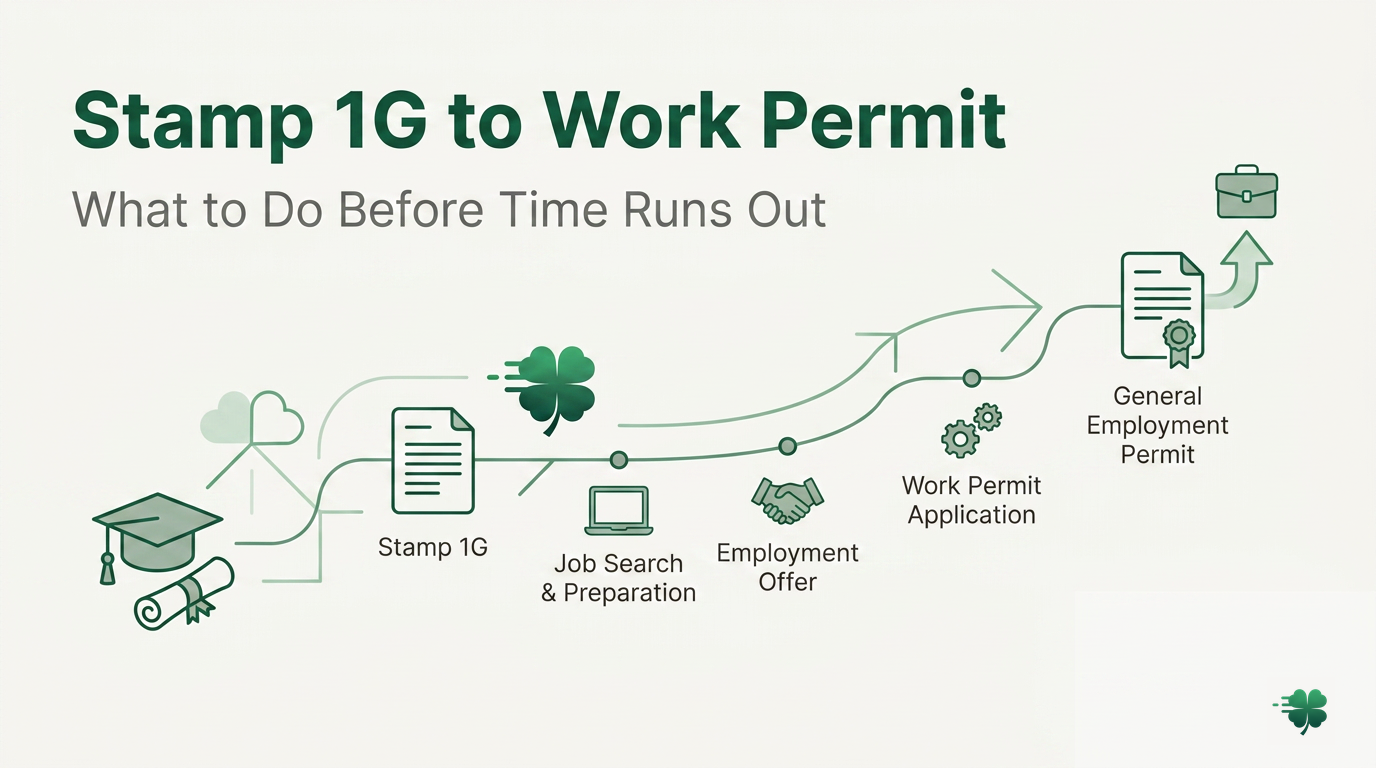
If you are a non-EU graduate in Ireland on a Stamp 1G permission, you may have a limited window to move from graduate permission into a role that could support an employment permit application. Depending on your award level, Stamp 1G gives you 12 or 24 months to remain in Ireland after graduation and look for work, as set out above. Always check the current Irish Immigration Service guidance for your specific situation.
Many international graduates on Stamp 1G apply broadly, hoping to land any job offer. However, without a focused, employment-permit-aware plan, this can lead to wasted time and missed opportunities as your runway shortens.
Official baseline
Stamp 1G conditions are governed by Irish immigration rules and should be checked with the Irish Immigration Service. Employment permits are issued by the Department of Enterprise, Tourism and Employment (DETE). This article is a planning framework, not legal or immigration advice. Individual circumstances vary. Official requirements, thresholds, processing times, and occupation lists may change.
For up-to-date official guidance, consult:
- [1] Irish Immigration Service — Stamp 1G / Third Level Graduate Programme
- [2] Department of Enterprise, Tourism and Employment — Employment Permits
Why applying broadly can waste limited runway
Applying to every open role you see is a natural instinct, but it is often inefficient for Stamp 1G holders. Many Irish employers are not familiar with, or are not prepared to support, employment-permit applications for every role. Many roles may also fail to fit the occupation, salary, contract, or permit-route requirements needed for an employment permit. Without focusing your efforts, you risk:
- Burnout: Endless applications with no results.
- Missed opportunities: Not identifying employers with visible employment-permit activity.
- Time pressure: Your Stamp 1G is ticking, and the permit application process itself takes time.
Learning to read Irish job ads for sponsorship signals helps you filter efficiently. A focused approach maximises your chances within your remaining window.
How to map status, role, salary, sector, and timeline before applying
Before you send out another CV, clarify these critical elements:
- Your current status and remaining time: How many months are left on your Stamp 1G? Your timeline changes depending on whether you have 18 months, 9 months, 3 months, or less.
- Your role and duties: Does your work align with occupations that may be relevant for an employment permit route? The likely SOC code should reflect your actual duties, not just your job title. See our explainer on what a SOC code means for Irish employment permits.
- Salary realism: Does the salary range for your target role look compatible with current remuneration thresholds for the relevant employment permit route?
- Target sectors: Which sectors show visible employment-permit activity and realistic demand for your type of role?
- Employer fit: Which employers have historical permit activity and roles that could plausibly match your profile?
- Your personal timeline: How much time do you realistically need for job search, interviews, offer negotiation, permit application, processing, and contingency planning?
IrishTalents provides tools and data to help you research these factors effectively.
How to use employer permit history as a research signal
Historical employment permit data, while not a guarantee of current hiring or future sponsorship, is a useful research signal. Employers with visible employment-permit history may be more useful research targets than employers with no visible signal, but past activity is not proof of current hiring or future sponsorship. For a deeper workflow, see our guide on how to research a company's sponsorship history before applying.
- Identify employers with historical permit activity: Use resources like IrishTalents Companies to see which employers have received employment permits.
- Look for patterns: Are certain companies in your sector recurring in permit data? Do they have permits for roles similar to yours?
- Understand limitations: Historical data reflects past permit activity, not live vacancies. Always verify current openings and permit-support policies with the employer.
What to prepare before employer conversations
Once you identify potential employers, prepare for direct conversations about the employment-permit process.
- Be informed: Understand permit types (Critical Skills vs. General), the application process, and what employer support typically involves.
- Highlight value: Focus on how your skills meet their needs and address documented shortages.
- Be proactive: Ask about their experience with international hires and the employment-permit process, timelines, and what employer support would involve.
- Manage expectations: Be realistic about timelines and potential challenges. Do not present sponsorship as a simple HR formality.
What this article cannot tell you
This article is a planning framework. It cannot determine:
- whether your specific Stamp 1G can be renewed, extended, or varied;
- whether your exact role qualifies for an employment permit;
- whether your salary meets current thresholds;
- whether an employer will support your permit application;
- whether a future permit application will be approved;
- whether you should stay in Ireland, study further, leave, or change immigration route.
Use this article as a planning framework, then verify your assumptions against official Irish Immigration Service and DETE guidance, or speak with a qualified adviser where appropriate.
When to consider qualified immigration or specialist support
For complex cases, specific legal queries, or if you encounter unique circumstances, consider consulting a qualified immigration advisor. They can provide tailored advice based on your individual profile and the latest regulations.
IrishTalents focuses on providing market intelligence and strategic planning tools, not legal advice.
How to build a 90-day Stamp 1G employment-permit action plan
A structured 90-day plan can help you use your remaining Stamp 1G time more deliberately.
Days 1–7: clarify your permit-fit baseline
- Confirm your Stamp 1G expiry date and how much time remains.
- Identify your likely employment-permit route: Critical Skills, General Employment Permit, or another route.
- Map your actual role duties to likely SOC areas, without treating the job title alone as final.
- Check current official guidance on salary thresholds and occupation lists.
- List your blockers: salary, occupation, employer willingness, registration, location, contract type, or timing.
- Decide whether you need qualified immigration or career support.
Days 8–30: build a focused employer shortlist
- Build a shortlist of 30–50 employers, not just a handful of famous brands.
- Prioritise employers with visible historical permit activity in your sector.
- Separate employers into A/B/C targets based on permit history, role fit, sector relevance, location, and current openings.
- Check each employer's careers page and current job ads.
- Use the IrishTalents company directory as a research layer, not as proof of current hiring.
- Prepare a CV and cover letter that explain your value clearly without over-focusing on sponsorship.
Days 31–60: apply, test, and refine
- Apply to roles where your duties, salary range, employer type, and permit route could plausibly align.
- Track response rates by sector, role type, and employer category.
- Speak with recruiters carefully, but do not pay fees for job placement.
- Use employer conversations to understand whether the company has experience supporting employment permits.
- Refine your shortlist based on real feedback.
Days 61–90: prioritise serious processes and contingency planning
- Prioritise interviews and employers that understand the employment-permit process.
- Avoid spending most of your remaining time on roles with weak permit fit.
- If your Stamp 1G time is short, consider speaking with a qualified adviser.
- Prepare contingency options: Critical Skills route, General Employment Permit route, further study, return plan, relocation plan, or extending your job search strategy where legally possible.
- Do not wait until the final weeks to understand your options.
Key takeaways
- Stamp 1G gives many non-EU graduates a limited window to move from graduate permission into a longer-term work route.
- Applying broadly can waste time if you are not checking permit fit, salary realism, employer willingness, and role alignment.
- Historical employment-permit activity is a useful research signal, but it is not a live vacancy feed or sponsorship guarantee.
- A stronger strategy combines permit-fit checks, employer research, targeted applications, and contingency planning.
- IrishTalents can help you research employer permit history and plan your next steps, but official guidance and qualified advice still matter.
Next step
Use your remaining Stamp 1G time as a planning window, not just an application window. Start by checking your likely employment-permit fit, then build a focused employer shortlist based on visible permit activity, role fit, salary realism, and current official guidance.
Begin with the Irish employment permit fit check, then research employers with historical permit activity in the IrishTalents company directory.
Sources
[1] Irish Immigration Service — Stamp 1G (Third Level Graduate Programme) — https://www.irishimmigration.ie/to-come-to-ireland/what-type-of-visa-do-i-need/study-and-the-third-level-graduate-programme/
[2] Department of Enterprise, Tourism and Employment — Employment Permits — https://enterprise.gov.ie/en/what-we-do/workplace-and-skills/employment-permits/